Fintech · Payments · Cross-Network UX
Fintech · Payments · Cross-Network UX
EMVCo (SRC Working Group · via American Express)
EMVCo (SRC Working Group · via American Express)
EMVCo Click to Pay: End-to-End Payment UX & Governance Framework
EMVCo Click to Pay: End-to-End Payment UX & Governance Framework
EMVCo Click to Pay: End-to-End Payment UX & Governance Framework
From Fragmented Payment Experiences to a Unified Global Standard
From Fragmented Payment Experiences to a Unified Global Standard
From Fragmented Payment Experiences to a Unified Global Standard
Role
UX Architecture Lead (American Express Representative · EMVCo SRC Working Group)
Scope
UX System Architecture
Cross-Network CX Standardization
Authentication Modernization (Passkey – Live)
Timeline
Multi-year Global Standardization Initiative
As American Express’s delegate to EMVCo — the global body governing payment standards across Visa, Mastercard, JCB, UnionPay, and Discover — I led the UX architecture that defines how Click to Pay is experienced globally.
I owned the end-to-end interaction model, co-authored CX Guidelines v1.2 with Passkey authentication to streamline onboarding and reduce authentication friction, and built the compliance framework that transitioned Click to Pay from network-by-network negotiation to scalable standards-driven execution — reducing implementation ambiguity across 6 payment networks and supporting consistent merchant adoption worldwide.
I contributed to early planning for v1.3, laying groundwork for onboarding and consent standardization ahead of Click to Pay's global rollout, targeted for 2027–2028.
🌐 The EMVCo Context
A Global Standard with a Fragmentation Problem
EMVCo governs the global standards enabling secure, interoperable payments across major international networks. Click to Pay was built under this mandate – to unify online card checkout across schemes and deliver a consistent experience worldwide.
In particular, it wasn't working that way. Each participating networks interpreted the standard differently. Authentication ownership was unclear. Consent models varied. The result was a fragmented ecosystem that undermined undermined consumer trust — and what Click to Pay was meant to represent.
Something more fundamental than a design refresh was needed.
🔥 The Structural Challenge
A Governance Problem, Not a UX Problem
The inconsistency wasn't aesthetic. Network-level priorities were overriding ecosystem alignment — creating divergent UX patterns, ambiguous authentication ownership, and fragmented consent models no single network could resolve alone.
Fixing this meant operatong at the standards level: aligning interation principles across competing stakeholders, stanblishing clear ownership, and embedding goverance directly into the experience architecture.
✅ My Objective
From Fragmentation Checkout Flows to a Unified Interaction Architecture
The goal wasn't to redesign screens. I led the effort to define the architectural foundation for consistent, scalable implementation — across hundreds of merchants, PSPs, and developer ecosystems simultaneously.
That required both designing the experience and ensuring it could hold as a global standard.
From Fragmentation to Unified Architecture
"This architecture became the foundation for EMVCo CX Guidelines and implementation standards."
From Fragmentation to Unified Architecture
🙋🏻♀️ My Role as AMEX Delegate
Leading and Designing Cross-Network UX Architecture
As American Express's delegate within the EMVCo SRC Working Group, I worked across two fronts: shaping Click to Pay as a global standard across all six networks, and doing the design work directly — owning checkout flows, authentication patterns, and edge case states the guidelines would be built around.
That meant facilitating alignment sessions, mediating competing priorities, and defining what needed to be locked down versus where flexibility could exist without breaking interoperability. Every design decision was traceable to API/SDK specs and qualification requirements.
Passkey integration — now live in v1.2 — was one key milestone, with the governance model continuing to evolve ahead of Click to Pay's global rollout in 2027–2028.
✳️ Key Impact
Establishing a Scalable Global CX Governance Framework
Working across all 6 networks, I translated governance principles into three concrete outcomes — an executable interaction model, a published global standard, and ecosystem-level tools that teams could actually build against.
1️⃣ Unified End-to-End UX Flow
1️⃣ Unified End-to-End UX Flow
2️⃣ Published Official CX Guidelines v1.2
2️⃣ Published Official CX Guidelines v1.2
3️⃣ Ecosystem-Level Execution Tool
3️⃣ Ecosystem-Level Execution Tool
1️⃣ Unified End-to-End UX Flow
I led the definition of standardized interaction structure that reconciled divergent scheme behaviors into a single, interoperable model – covering authentication flows, card prioritization, co-badge logic, fallback behaviors, and state transitions across schemes.
Returning User Authentication Flow (Passkey Example)
2️⃣ Published Official CX Guidelines v1.2
Working alongside cross-network partners and technical stakeholders, I co-shaped and published EMVCo's official Click to Pay CX Guidelines v1.2 – embedding Passkey-based authentication as a core interaction flow and aligning every UX decision with API, SDK, and qualification requirements.
EMVCo Click to Pay CX Guidelines v1.2 (Published Standard)
3️⃣ Ecosystem-Level Execution Tool
I designed and developed a cross-functional Quick Step Guide that translated the CX Guidelines into role-specific checkpoints – enabling consistent integration across UX, engineering, payments, merchants, and integrators across markets.
Standard Asset Usage — Quick Step Guide Example
Phase 1
Operationalizing the Architecture
Phase 1
Operationalizing the Architecture
Translating ecosystem complexity into a scalable executable UX
Translating ecosystem complexity into a scalable executable UX
In Phase 1, I worked with stakeholders across schemes to consolidate fragmented implementation patterns into a single, standards-ready interaction model — balancing usability, compliance, scheme neutrality, and interoperability.
In Phase 1, I worked with stakeholders across schemes to consolidate fragmented implementation patterns into a single, standards-ready interaction model — balancing usability, compliance, scheme neutrality, and interoperability.
🤝 Cross-Network Alignment
Establishing Shared Decision Principles Across Schemes
Click to Pay operates within a multi-stakeholder ecosystem where divergent interpretations naturally emerge across participating networks and technical stakeholders.
To reconcile these differences, structured cross-network alignment was facilitated to clarify implementation boundaries, interaction ownership, and neutrality constraints.
Rather than harmonizing visual patterns, the focus was on formalizing shared decision principles — defining what must remain standardized across schemes and where controlled flexibility could exist without compromising interoperability. (Figure 02. Click to Pay Cross-Boundary E2E Interaction Model)
This alignment established the governance foundation for a unified, standards-ready interaction architecture.
🤝 Cross-Network Alignment
Establishing Shared Principles Before Designing Anything
Click to Pay operates within a multi-stakeholder ecosystem where divergent interpretations naturally emerge across participating networks and technical stakeholders.
Rather than jumping straight into design, I facilitated structured alignment sessions to surface conflicting assumptions and clarify implementation boundaries, interaction ownership, and neutrality constraints. The focus wasn't on harmonizing visual patterns — it was on defining shared decision principles: what had to remain standardized across schemes, and where controlled flexibility could exist without compromising interoperability.
That alignment became the governance foundation everything else was built on.
🗒️ Applying the Alignment Framework Across Critical Interaction Moments
With shared principles established, I applied them across the high-impact interaction moments that would shape the core experience.
Divergent Interpretations Across Key Interaction Moments
A. Product Education (Adoption Moment)
Divergent Interpretations Across Key Interaction Moments
B. OTP; One-time Passcode Verification (Authentication Moment)
❇️ Defining the End-to-End Interaction Architecture
Turning Decision Principles into an Executable Experience
With shared principles in place, I translated them into a Cross-Boundary End-to-End Interaction Model — mapping responsibility boundaries, authentication triggers, card prioritization logic, and fallback behaviors across the ecosystem.
Rather than keeping alignment as an abstract framework, I embedded it directly into an executable model that stakeholders across networks could actually build against.
"Governance translated into behavior."
"Governance translated into behavior."
Cross-Boundary E2E Interaction model
📱 Designing the Screen-Level Experience
Making the Architecture Real for Users
With the architecture defined, I designed the full end-to-end screen experience — mapping how users move from checkout entry through identification, authentication, card selection, and confirmation, including alternate paths for enrollment and challenge flows.
Every screen was shaped around three questions: Does the user understand what Click to Pay is? Do they know when they're using it? Is it clearly distinct from other digital wallets?
To make the architecture real at the screen level, I defined two frameworks through close collaboration with stakeholders across schemes:
✔️ How the Architecture Was Operationalized at the Screen Level:
✔️ How the Architecture Was Operationalized at the Screen Level:
✔️ How the Architecture Was Operationalized at the Screen Level:
Three Core Interaction States
I structured the journey into three core states to operationalize the architecture:
- Recognition & Identification
- Selection & Authentication
- Confirmation & Recovery
These states defined transition logic, ownership across merchant and Click to Pay touchpoints, and fallback behavior — enabling scalable, consistent implementation across schemes.
Three Guiding Experience Principles
I guided screen-level execution through three core principles:
- Clarity over complexity
- Predictable state transitions
- Balance usability and compliance
Together, these principles ensured that structural rigor enhanced — rather than compromised — user comprehension.
🚀 Screen Patterns: Baseline to Modernization
Designing for Stability and Evolution
I established the foundational screen patterns that operationalize the architecture — covering authentication pathways, state transitions, and responsibility handoffs across schemes.
The v1.1 baseline standardized OTP-based authentication as the starting point. When Passkey became viable, I evolved the same patterns to absorb the modernization — enabling friction reduction without compromising interoperability, neutrality, or qualification requirements.
This pattern evolution demonstrates the architecture's core value: stable enough to standardize across schemes, flexible enough to modernize without starting over.
🔗 View the Full Key Moments & Flows v1.2
🚀 Representative Screen Patterns
Scalable Screen-Level Implementation Across Schemes
With the architectural framework and guiding principles defined, the next step was translating them into executable screen-level patterns.
Building on the Three Core Interaction States and Three Guiding Experience Principles, foundational interaction patterns were established to operationalize the architecture in practice.
These patterns ensured that authentication pathways, state transitions, and responsibility boundaries were consistently applied across schemes – while remaining adaptable to evolving standards.
🔗 View the Full Key Moments & Flows v1.2
🔁 Pattern Evolution: From Baseline to Modernization
The foundational authentication pattern began with a standardized OTP-based flow (v1.1), establishing the initial cross-network alignment baseline.
As the standard evolved, the same architectural framework supported modernization through Passkey integration (v1.2), enabling friction reduction without compromising interoperability, neutrality, or qualification requirements.
→ Based Authentication Flow (v1.1 – OTP)
🚀 Representative Screen Patterns
Designing for Stability and Evolution
With the architectural framework and guiding principles defined, the next step was translating them into executable screen-level patterns.
Building on the Three Core Interaction States and Three Guiding Experience Principles, foundational interaction patterns were established to operationalize the architecture in practice.
These patterns ensured that authentication pathways, state transitions, and responsibility boundaries were consistently applied across schemes – while remaining adaptable to evolving standards.
🔗 View the Full Key Moments & Flows v1.2
Returning User Authentication Flow (v1.1 – OTP)
→ Modernized Authentication Flow (v1.2 – Passkey)
→ Authentication Evolution: OTP to Passkey
🔁 Pattern Evolution: From Baseline to Modernization
The foundational authentication pattern began with a standardized OTP-based flow (v1.1), establishing the initial cross-network alignment baseline.
As the standard evolved, the same architectural framework supported modernization through Passkey integration (v1.2), enabling friction reduction without compromising interoperability, neutrality, or qualification requirements.
→ Based Authentication Flow (v1.1 – OTP)
→ Modernized Authentication Flow (v1.2 – Passkey)
→ Authentication Evolution: OTP to Passkey
📋 Research & Validation – with IPSOS
Global Behavioral Testing Across Markets
In partnership with IPSOS, I ran iterative validation cycles across 4 markets — the UK, Australia, Brazil, and the US — to pressure-test whether the architecture could drive adoption at ecosystem scale, not just pass technical compliance.
1️⃣ Click to Pay Recognition Gap
1️⃣ Click to Pay Recognition Gap
Brand recognition remained critically low across all markets. This drove a decision — collaborated across all participating networks — to extend the Click to Pay icon beyond e-commerce, adopting it across every payment touchpoint where networks operate, to build familiarity at scale.
Brand recognition remained critically low across all markets. This drove a decision — collaborated across all participating networks — to extend the Click to Pay icon beyond e-commerce, adopting it across every payment touchpoint where networks operate, to build familiarity at scale.
2️⃣ Product Education Is Critical
2️⃣ Product Education Is Critical
Users consistently mistook Click to Pay for a digital wallet. This reinforced embedding product education moments directly into the core interaction flow — not as optional onboarding, but as a structural part of the experience.
Users consistently mistook Click to Pay for a digital wallet. This reinforced embedding product education moments directly into the core interaction flow — not as optional onboarding, but as a structural part of the experience.
3️⃣ Strong Preference for Passkey
3️⃣ Strong Preference for Passkey
69%+ preferred Passkey over OTP, driven by perceived security and ease — directly validating its integration as a core flow in v1.2
69%+ preferred Passkey over OTP, driven by perceived security and ease — directly validating its integration as a core flow in v1.2
“If it was already set up through my bank then I would definitely use it because its convenient, its fast and its secure.”
“If it was already set up through my bank then I would definitely use it because its convenient, its fast and its secure.”
“If it was already set up through my bank then I would definitely use it because its convenient, its fast and its secure.”
“If this is different from other digital wallets like Apple Pay or Samsung Pay, I need to understand how. I’d expect my bank or card network to explain what makes it different.”
“If this is different from other digital wallets like Apple Pay or Samsung Pay, I need to understand how. I’d expect my bank or card network to explain what makes it different.”
“If this is different from other digital wallets like Apple Pay or Samsung Pay, I need to understand how. I’d expect my bank or card network to explain what makes it different.”
Phase 2
Formalizing the Architecture
Phase 2
Formalizing the Architecture
Turning a Design Framework into an Official Global Standard
Turning a Design Framework into an Official Global Standard
Phase 1 produced a validated, governance-ready UX architecture. Phase 2 was about making it official — collaborating with stakeholders to ensure it could be implemented consistently across hundreds of merchants, PSPs, integrators, and developer ecosystems worldwide.
Phase 1 produced a validated, governance-ready UX architecture. Phase 2 was about making it official — collaborating with stakeholders to ensure it could be implemented consistently across hundreds of merchants, PSPs, integrators, and developer ecosystems worldwide.
🚧 The Problem I Was Solving
Ambiguity Was Costing the Ecosystem
Existing CX guidance was interpreted differently across stakeholders — producing fragmented checkout flows, prolonged alignment cycles, and delayed merchant launches globally. The fix wasn't more design. It was structural precision.
🏗️ The CX Standard
Shifting from Negotiation-Driven to Standards-Driven
Working with partners across schemes, I embedded the UX architecture directly into the Click to Pay CX Guidelines — eliminating interpretation gaps by defining clear ownership, standardized authentication pathways, and qualification checkpoints tied to implementation milestones.
This shifted Click to Pay from a standard that got re-negotiated at every merchant integration to one that implementation teams could execute against independently.
🏗️ The CX Standard
Shifting from Negotiation-Driven to Standards-Driven
Working with partners across schemes, I embedded the UX architecture directly into the Click to Pay CX Guidelines — eliminating interpretation gaps by defining clear ownership, standardized authentication pathways, and qualification checkpoints tied to implementation milestones.
This shifted Click to Pay from a standard that got re-negotiated at every merchant integration to one that implementation teams could execute against independently.
📢 Official Publication
Click to Pay CX Guidelines v1.2
The architecture was formally published as the EMVCo Click to Pay CX Guidelines v1.2 — aligning every interaction pattern with API, SDK, accessibility, and qualification requirements, and establishing the implementation standard for the global ecosystem.
🔗 View CX Guidelines v1.2
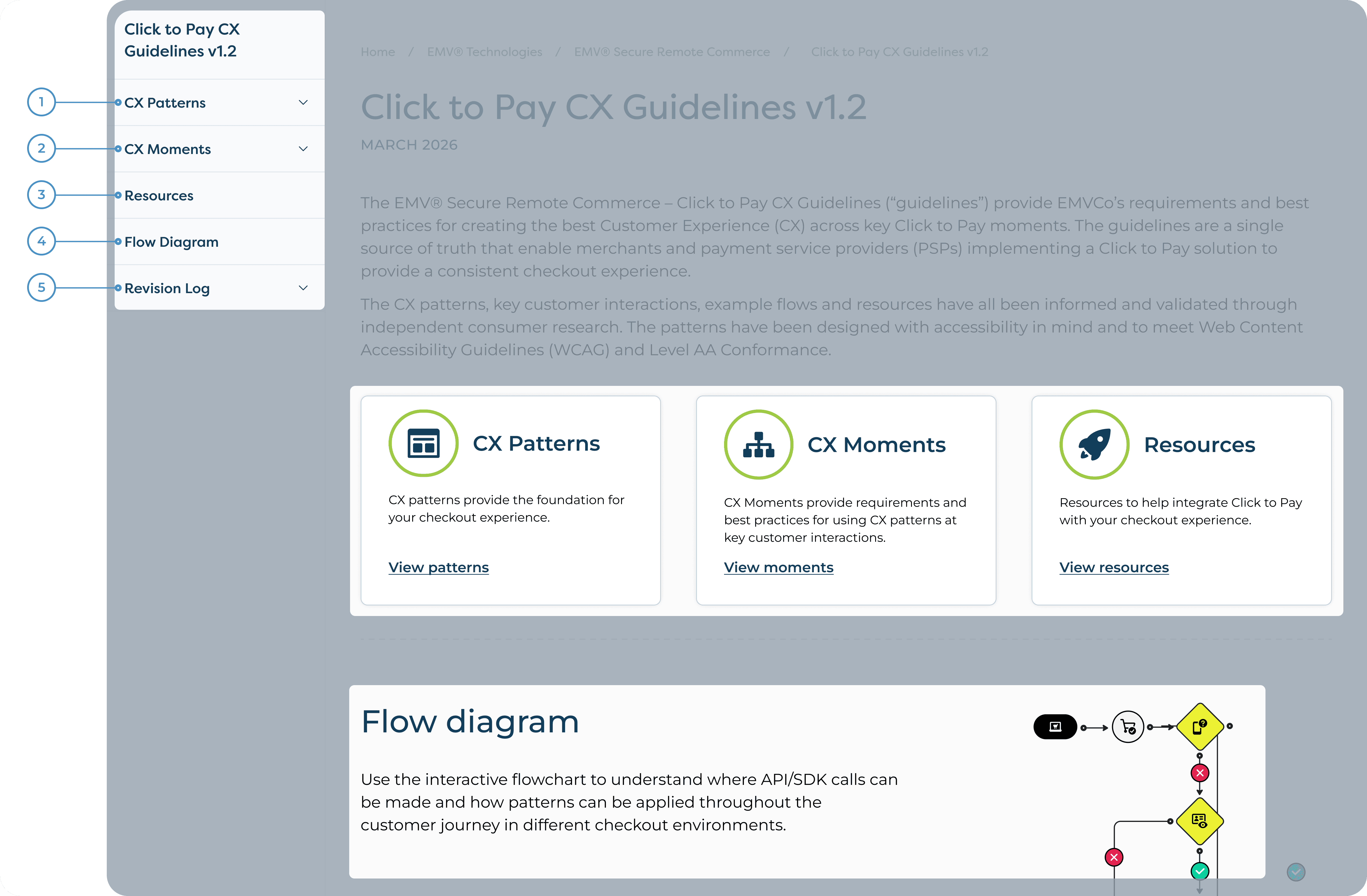
→ Landing Page with Key Navigations
→ Landing Page with Key Navigations
CX Patterns: Reusable building blocks defining the visual and interaction standards for a consistent checkout experience.
CX Moments: Requirements and best practices mapped to critical customer touchpoints — from card recognition to payment confirmation.
Resources: Technical assets, API/SDK references, and integration guides to support merchant and PSP implementation at scale.
Flow Diagram: An interactive checkout flow showing where API calls trigger, logic branches, and CX patterns apply.
Revision Log: Version history tracking all updates to the guidelines — ensuring alignment across global stakeholders and implementation teams.
CX Patterns: Reusable building blocks defining the visual and interaction standards for a consistent checkout experience.
CX Moments: Requirements and best practices mapped to critical customer touchpoints — from card recognition to payment confirmation.
Resources: Technical assets, API/SDK references, and integration guides to support merchant and PSP implementation at scale.
Flow Diagram: An interactive checkout flow showing where API calls trigger, logic branches, and CX patterns apply.
Revision Log: Version history tracking all updates to the guidelines — ensuring alignment across global stakeholders and implementation teams.
CX Guidelines v1.2 – Landing Page
CX Guidelines v1.2 – Resources
CX Guidelines v1.2 – CX Moments (Displaying linked cards)
🔑 Key Impact
From Architecture to Global CX Standard
In Phase 2, I elevated a validated UX architecture into a global implementation standard.
✦ Reduced cross-network interpretation gaps
✦ Accelerated merchant onboarding timelines
✦ Improved interoperability across schemes
✦ Created the foundation for scalable authentication modernization — Passkey first, with more to follow
By embedding shared decision principles into the official CX Guidelines, I shifted Click to Pay from alignment-driven coordination to standards-driven execution.
📚 What I Learned
Beyond the Screen — What This Project Really Required
The most important design decisions don't happen on a screen.
Knowing when to push for standardization and when to allow flexibility was as much a design skill as any interaction pattern.
The challenge wasn’t just defining ideal patterns, but deciding where consistency created scale and where flexibility was necessary for adoption.
Ambiguity at scale is a design problem.
Any gap in the standard gets filled later by someone without full context — and across hundreds of merchants, that compounds fast. Documentation and handoff are part of the design work, not separate from it.
Influence without authority is a core design skill.
Working across 6 networks with competing priorities, I learned that alignment doesn’t happen through better design alone — it’s built through trust, structured facilitation, and showing up with a point of view that accounts for everyone else’s constraints.
The most effective moments weren't about having the right answer – they were about asking the right question at the right time.
Thank You!